Christmas in Switzerland: Traditions, Festive Food and Family Memories

For me, Christmas in Switzerland brings back memories of a pair of scissors and my mother’s homemade Advent calendar. She made a big wall hanging displaying a winter scene with a train running through it, with little packages attached, and every morning, my brothers and I would cut one down. It was a very good reason to get out of bed.
Then there was the baking. Christmas cookies were a very important event, and my mother always made the full selection. I loved helping her, and we both had our favourite doughs to nibble on as we worked.
I’m Swiss-born and grew up in Canada, where these traditions were part of our family Christmas. We celebrated on December 24, dressed up for supper, and waited upstairs for a bell to ring before we could come down to the tree.
Christmas in Switzerland includes Advent customs, festive baking and family celebrations, but it looks a little different from one household and region to another. Here’s a look at some of those traditions, along with the ones I grew up with.
Advent: the weeks leading up to Christmas
Advent gives the weeks before Christmas their own little rituals. Advent calendars count down the days, while a traditional Advent wreath holds four candles, with another lit on each of the four Sundays before Christmas.
Every Sunday of Advent, we would gather around our Advent wreath, light the candles and sing German and Swiss German Christmas songs together, including “O Tannenbaum.” With another candle lit each week, we were getting a little closer to Christmas. Those evenings were as much a part of the season as Christmas Eve itself.
One of my favourites was the Swiss German song “Es Schäfli tuen em bringe,” from Paul Burkhard’s D Zäller Wiehnacht. It’s about bringing gifts to baby Jesus, beginning with a little lamb. I loved it as a child, and all these years later, I can still remember bits of the words.
If you’d like to bring this tradition into your own home, a homemade calendar can be as simple as small numbered packages or envelopes. You could fill them with treats, little notes or activities to do together: bake cookies, make a decoration or call someone you miss.
Samichlaus, December 6 and a sack of treats
In German-speaking Switzerland, St. Nicholas is known as Samichlaus, and his day is December 6. For North American readers, he may look familiar, but his visit has a different purpose from Santa’s Christmas Eve delivery.
Traditionally, Samichlaus comes to talk with children about how they’ve behaved during the year: praising what they’ve done well and reminding them where they could do better. Children often prepare a little poem or song to perform for him, and there are nuts, mandarins and chocolate to enjoy. It’s a visit with a conversation, a little anticipation and, for some children, a few nerves.
He is often accompanied by Schmutzli, his traditionally dark-robed helper. Older versions of the custom could be quite stern, with Schmutzli playing the frightening companion. Many present-day organisers emphasise a friendly, encouraging visit that children don’t need to fear.
Of course, my brothers and I wanted to know how Samichlaus could possibly know whether we’d been good. My mother had an answer: a squirrel would report back to him. That was the explanation in our house – Samichlaus had a little woodland helper keeping him informed.

In our family, we would find a sack at the door filled with nuts, fruit and chocolate. We also had Grittibänz, the little bread figures associated with St. Nicholas Day.
Made from lightly sweetened bread dough, Grittibänz have shaped arms and legs and their own individual character. They’re one of those foods that make the occasion instantly recognisable.
The names and celebrations differ across Switzerland’s language regions, so the Samichlaus tradition I knew isn’t the exact version every Swiss child grows up with.
Find my Grittibänz recipe here
Swiss Christmas cookies: making the full selection
For me, you can’t talk about a Swiss Christmas without talking about the cookies.
My mother didn’t just make one batch and call the baking done. There was a full selection to work through, and helping her was one of my favourite parts of the lead-up to Christmas. We each had our preferred doughs to sneak a little taste of along the way.

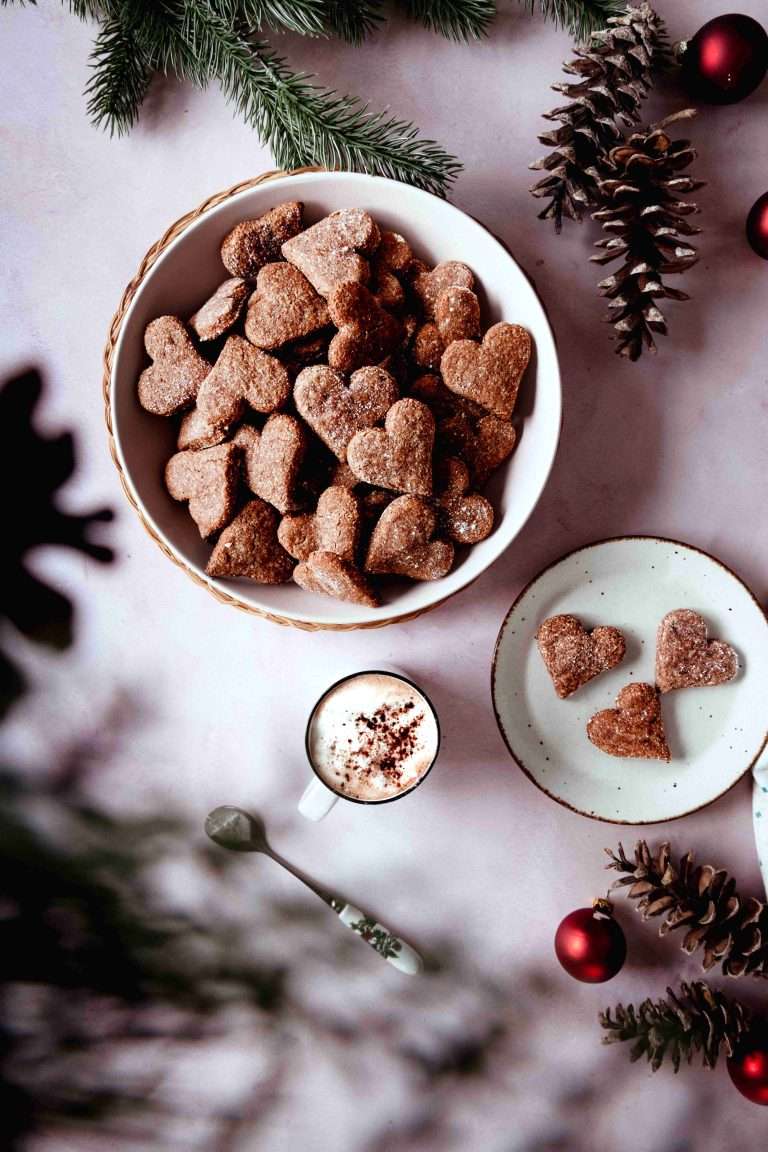
A Swiss Christmas cookie plate brings together different shapes, flavours and textures. There might be buttery Mailänderli, jam-filled Spitzbuebe, cinnamon stars called Zimtsterne, and anise-flavoured Chrabeli. Every family has its favourites and its own idea of what belongs in the tin.
If you’re new to Swiss Christmas baking, Mailänderli are a good place to begin. For something different alongside them, try my jam-filled Spitzbuebe or crisp hazelnut Nussstängeli.
What I remember most is being there with my mother, working our way through the baking together. By Christmas Eve, those cookies had a place at the table, too: they were our dessert after supper.

FROM MY SWISS KITCHEN
A Little Taste of Switzerland, Every Week.
Swiss favourites, seasonal baking, and recipes worth making again. Join me for weekly cooking inspiration, delivered straight to your inbox.
Free recipes every week. Unsubscribe anytime.
Christmas markets in Switzerland
Beyond the traditions at home, Christmas markets are another part of the season. Cities including Basel, Zurich and Montreux host markets where visitors can browse stalls, find gifts and stop for something to eat.
The food is part of the appeal: a mug of Glühwein, the warm, spiced wine served during the festive season, or raclette, with melted cheese served over potatoes. Offerings vary from market to market, but there’s plenty of reason to arrive hungry.
They’re a different way to experience the holiday: walking among the lights, looking at decorations and deciding which food stall to try next.
If you’re planning a visit, check the individual market’s official dates before making arrangements. Markets don’t all open and close on the same days.
Christmas Eve: waiting for the bell
In our family, the main celebration happened on the evening of December 24.
If you grew up in North America, you may be used to Santa Claus arriving overnight and leaving presents to open on Christmas morning. In many Swiss German families, that Christmas gift-giving role belongs to the Christkind, or Christchindli, and the excitement happens on Christmas Eve.
The name Christkind means “Christ Child,” though the Christmas gift-bringer is often imagined as an angel-like figure. You might remember Samichlaus from earlier in this article: he looks more like the Santa North American children know, but his visit is on December 6, when he brings nuts, fruit and chocolate. The Christkind brings the Christmas presents.
And that’s where the bell comes in. Children wait in another room while the Christkind is said to visit unseen. When the little bell rings, it means the presents are ready and they can come in to see the tree.
We would get dressed up and wait upstairs until we heard it ring. Only then could we come down to the Christmas tree, glowing with real candles, and the presents underneath it. The bell was our signal that the waiting was finally over.
That moment is still one of my clearest Christmas memories. After all the mornings at the Advent calendar, the Sunday candles and the baking, Christmas had finally arrived.
Many Swiss families celebrate and exchange gifts on Christmas Eve, while others open presents on Christmas morning. There isn’t one timetable that every household follows.
What do Swiss families eat for Christmas dinner?
There isn’t a single Christmas dinner served across Switzerland. Family habits and regional preferences both shape the meal.
Fondue chinoise is one well-established festive choice. Despite its name, it isn’t cheese fondue: thin slices of meat are cooked in hot broth and eaten with sauces and accompaniments. It’s the sort of meal that lets everyone stay at the table and take their time.

In our house, Christmas supper was usually a roast with potatoes and steamed vegetables, such as green beans and carrots. Then came the Christmas cookies.
If you’re putting together your own festive supper, my orange glazed carrots would make a colourful side dish. They aren’t a traditional Swiss Christmas requirement – just something from my kitchen that I’d happily add to a holiday table.
Get my Orange Glazed Carrots recipe here
Regional traditions: December in Geneva
Some December customs belong to a particular city or canton. Geneva’s Fête de l’Escalade, for example, commemorates the city’s defence against an attack in 1602. Although it falls during the festive season, it is a separate historical celebration.
One of its best-known food traditions is breaking a chocolate cauldron, or marmite. It’s a reminder that December in Switzerland includes local celebrations as well as the customs shared across many homes.
January 6: Three Kings’ Cake
There’s another baking tradition to look forward to after Christmas. On January 6, Epiphany, families share Three Kings’ Cake. In German-speaking Switzerland, Dreikönigskuchen is typically a lightly sweetened yeast bread, shaped into a cluster of buns and often made with raisins or chocolate chips.

A little king figure or an almond is hidden inside, and whoever finds it is crowned king or queen for the day. In French-speaking Switzerland, you may also find galette des rois, the puff pastry version. It’s a cheerful way to carry the festive season into January – and another reason to gather around something freshly baked.
Find my Dreikönigskuchen recipe here.
Bringing a little Swiss Christmas into your home
You don’t need to recreate every tradition to make one part of your own Christmas. Bake a batch of Swiss cookies, make a simple Advent calendar, or set aside a Sunday evening to light a candle and sing together.
For me, it’s the small details that have stayed: cutting a package from my mother’s calendar, helping with the cookies, and listening for that bell on Christmas Eve.
Those are the parts of a Swiss Christmas I love sharing. And if you begin with the baking, I completely understand.
Did you grow up with Swiss Christmas traditions, or does your family have a holiday ritual you still look forward to? I’d love to hear about it in the comments.
A Little Taste of Switzerland in Your Inbox
Traditional Swiss favourites, seasonal recipes, and a few family traditions along the way. Join me every week for a little inspiration from the Swiss kitchen.